position at the mouth of Salt River, its proximity to Louisville, and its access to roads and
river landings made the town a vital Union supply base. The hills above West Point soon filled
with soldiers, fortifications, hospitals, and the daily tension of a border state at war.
Why West Point Mattered
Long before the first shovel of earth was turned on Pearman Hill, the junction of the Salt and
Ohio Rivers made West Point one of the most strategically important locations in Kentucky.
When Kentucky’s neutrality collapsed in the fall of 1861, the Union Army moved quickly to secure
the state. Louisville became a major supply depot, and West Point—just 25 miles downstream—was
the natural transfer point for moving troops and equipment south.
Steamboats carried supplies down the Ohio River to West Point, where wagon trains hauled them
inland to training camps and forward positions. Roads, river landings, and the narrow valley
leading south made this junction a logistical choke point.
southern Kentucky. The Union could not afford to lose this corridor.
Fort Duffield and the Union Defense of West Point
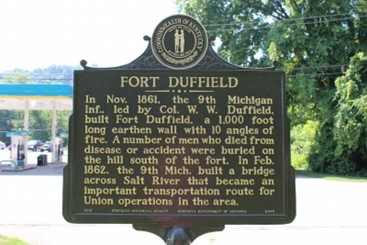
In the fall of 1861, Union General William T. Sherman ordered a fort built on the ridge
overlooking West Point to protect the supply depot below. Soon after, the 9th Michigan
Infantry constructed Fort Duffield, a 1,000‑foot earthen fortification with ten
angles of fire. Its purpose was simple: guard the rivers, roads, and supply lines feeding
the Union Army’s advance into the South.
At least sixty‑one Union soldiers died from disease or accident during the winter of
1861–62. They were buried on the hill south of the fort, forming the earliest military
cemetery associated with Fort Duffield.

Sherman’s Headquarters — The Judge Fisher Home
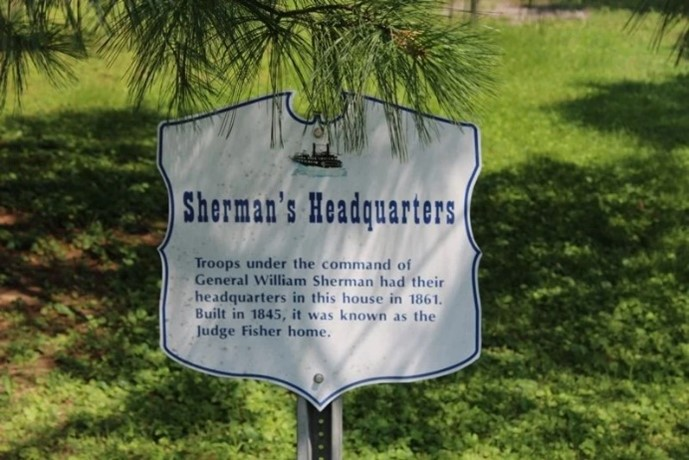
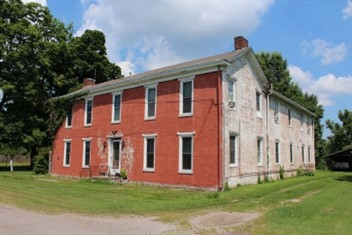
During the early months of the war, troops under General William T. Sherman used the
Judge Fisher Home (built in 1845) as their headquarters. From this house, Sherman
oversaw the defense of the river crossing, the supply base, and the early fortifications
that preceded Fort Duffield.
The home still stands today — a quiet reminder that West Point’s streets once hosted some
of the most important Union commanders in the Western Theater.
Hospitals and Hardship — The Ditto–Lansdale House
Disease swept through the Union camps during the winter of 1861–62. Measles, pneumonia,
exposure, and poor sanitation overwhelmed regimental surgeons. Several West Point homes
were converted into makeshift hospitals, including the Ditto–Lansdale House and the
Ditto–Prewitt House.
Many local women had husbands, brothers, or sons serving in the Confederate Army — yet
they nursed Union soldiers without hesitation. Their compassion transcended Kentucky’s
divided loyalties.
Among these caregivers, none is remembered more tenderly than Malvina “Miss Mallie” Hall.
She moved from bedside to bedside with blankets, broth, and comfort. When veterans of the
9th Michigan returned in 1895, the first question many asked was, “Where is Miss Mallie?”
They were saddened to learn she had died of fever in 1862. Though she wished to be buried
beside the soldiers she cared for, she was laid to rest in the Young Family Cemetery —
today known as Founders Cemetery.
Life in a Border State
rivers and roads, while Confederate cavalry operated throughout central Kentucky. Rumors
of raids and troop movements kept soldiers on edge, even though no direct attack ever
reached the fort.
The presence of Fort Duffield — and the thousands of soldiers who passed through West Point —
transformed the town. Homes became hospitals, fields became camps, and the ridge above the
river became a fortified line of defense.
Troops on the Move
In early 1862, West Point became a staging area for major Union offensives. Brigadier General
William “Bull” Nelson departed from here with his 4th Division, embarking on steamboats bound
for the Tennessee and Cumberland River campaigns.
In March 1862, the 9th Michigan left with the 23rd Brigade under Colonel William W. Duffield.
Thousands of soldiers passed through West Point during this period, many of whom would fight in
the pivotal battles of the Western Theater.
After the War Moved South
Following the Battle of Perryville in October 1862, the main fighting shifted deeper into
Tennessee. The artillery and munitions at Fort Duffield were ordered back to Louisville, and
the fort was left largely undisturbed except for occasional guerrilla activity.
Though never attacked, Fort Duffield’s commanding position played a vital role in securing
Kentucky during the critical first year of the war.
The 9th Michigan After Leaving West Point
After departing West Point, the 9th Michigan continued its service in Tennessee. By early 1863,
the regiment was assigned to Major General George H. Thomas in Murfreesboro, where it
served as provost and headquarters guard following the Battle of Stones River.
January 19, 1863 by Adjutant Anson A. Norton to Lieutenant Colonel Hume.
Norton describes the regiment’s condition, the aftermath of battle, and the challenges of
rebuilding lost records.
Read the January 19, 1863 Murfreesboro Letter →