Historic View
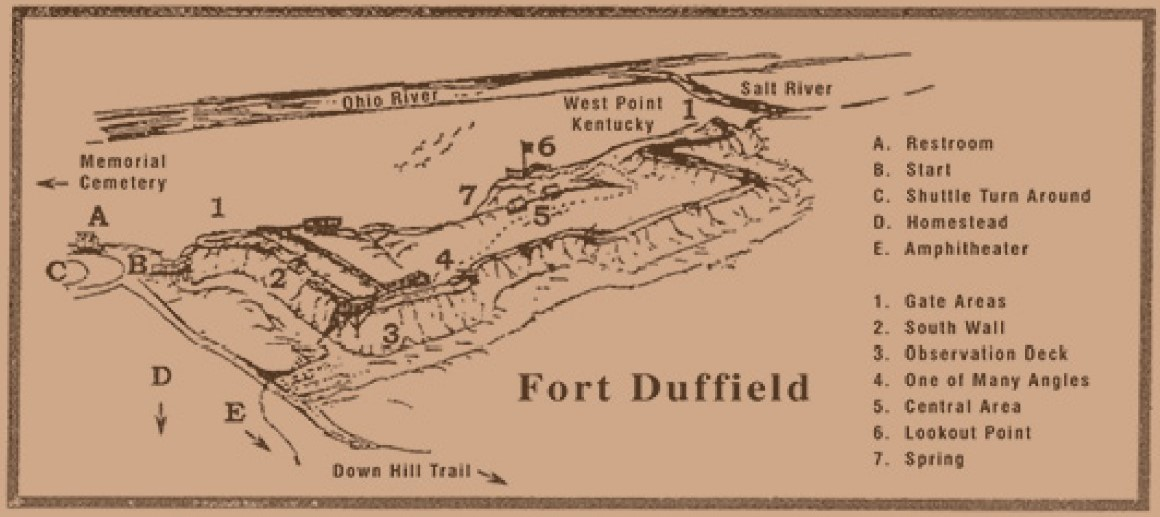
Walking Tour Map
Observation Point
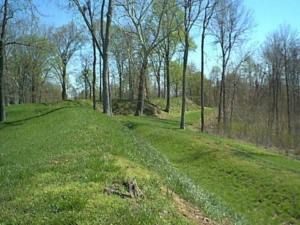
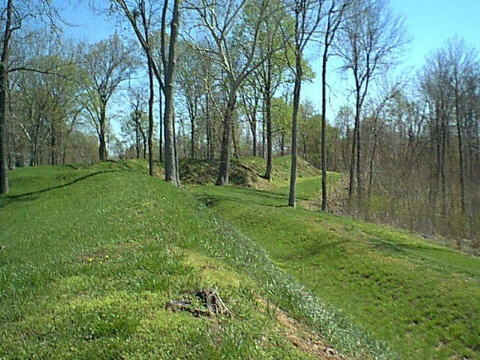
If you were to stand at this observation point during the Civil War, you would see how impregnable the fort must have been. The forest you see today did not exist — the hillside was cleared for at least a mile in every direction. With such a commanding view and a garrison of 1,000 men, it is no wonder this massive fortification was never attacked.
What Happened Here
Southern Redoubt and Replica Homestead
As you look south, you’ll notice a shallow depression in the earth — this is the fort’s redoubt. A redoubt is a small, detached defensive earthwork placed forward of the main walls to give soldiers a clear field of fire and early warning of any advancing enemy. Today, this area serves as an amphitheater for programs and events.
Adjacent to the redoubt stands a replica homestead, modeled after the simple log cabins common in mid‑19th‑century Kentucky. These homesteads once dotted the Bluegrass countryside, and their open yards would have provided Confederate scouts with cover during a southern approach.
The 9th Michigan Infantry focused much of their attention on this southern sector, knowing that any assault would likely come across these farms and fields. To the north, the 300‑foot cliff formed an imposing natural barrier that protected the fort’s front approach. From the front of the fort, soldiers could overlook the Ohio River far below.
“The Battle of the Pickax”
Companies E and G were then alone on the hill and expected to be the first ones gobbled up; but reinforcements came up to us on the double‑quick. This performance was repeated three times before morning, caused by other nervous sentinels ‘seeing something.’
The absurdity of it was that no rebels were nearer than Bowling Green, 50 miles away, and our army was between us. But we were all ‘raw’ then and imagined there was a rebel behind every bush, tree, and knob — and several luckless pigs lost their lives by being too inquisitive after dark.”
Listen or Explore More
Audio Narration
Hear how the Observation Deck shaped vigilance, fear, and daily guard duty at Fort Duffield.
Primary Sources & Research
Primary Sources Coming Soon
Archival documents, maps, and engineering notes for this stop are being prepared and will be added soon.
Navigation
Walking Tour Quick Links
© 2026 Fort Duffield • Built with GeneratePress