Living with a river
opportunity also brought destruction. From the 1800s to the present day, floods reshaped the
town again and again — testing the strength, ingenuity, and resilience of its people.
The Ohio and Salt Rivers — A Blessing and a Threat
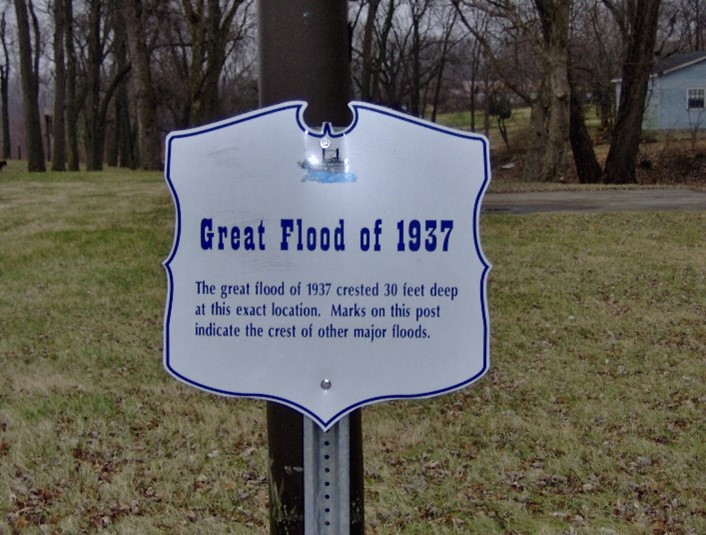
West Point sits at the confluence of the Ohio and Salt Rivers — a location that made it a
natural landing, a commercial hub, and a gateway for travelers moving between Kentucky and
the wider Ohio Valley. But this geography also placed the town directly in the path of
seasonal flooding. High water was a familiar part of life, and generations of residents
learned to adapt: raising goods, building on higher ground, and watching the river with
practiced eyes.
Yet some floods rose far beyond the ordinary. These were the events that left lasting marks
on the community and shaped the town’s identity.
Clara Barton’s First Arrival in West Point
Before the full story of the 1884 Flood unfolds, it helps to understand how
Clara Barton first became connected with West Point. As heavy rains, melting snow, and
rising river levels swept across the Ohio Valley, Barton — then leading the newly formed
American Red Cross — monitored the worsening conditions with growing concern.

West Point’s position at the confluence of the Ohio and Salt Rivers made it especially
vulnerable. As reports of stranded families, collapsing riverbanks, and widespread destruction
reached her, Barton recognized that the community faced a disaster far beyond its own capacity
to manage. The need for organized relief was immediate and overwhelming.
Her decision to travel to West Point marked one of the earliest major deployments of the
American Red Cross in a natural disaster. What began as a response to urgent need would become
a defining chapter in both the town’s history and the early legacy of the Red Cross.
The section below tells the full story of her work in West Point — from the moment the
Mattie Hays relief boat approached the flooded town to the weeks she spent assisting
families from her temporary headquarters in the James Young House.
The Flood of 1884 — Clara Barton and the Red Cross in West Point
The Flood of 1884 remains one of the most destructive natural disasters ever to strike
West Point. Heavy snows, a sudden thaw, and days of torrential rain sent the Ohio River
surging to heights never before recorded. By early February, 48 of the town’s 50 homes were
underwater. Families crowded into attics, rooftops, and the few structures that remained
above the rising water.
Food and fuel ran out. Mail service had been cut off for more than a month. A bitter windstorm
on February 22 shattered homes that had barely survived the flood itself. Entire blocks along
Water Street — once lined with elegant riverfront mansions — collapsed into the river as the
saturated ground gave way.
— Major E. B. Kirk, U.S. Army Quartermaster Corps, February 16, 1884
Responding to the crisis, General Saxton leased the packet boat Mattie Hays and loaded it
with supplies in Louisville. Aboard that vessel was Clara Barton, founder of the American
Red Cross — an organization still in its infancy. As the Mattie Hays approached West Point,
Barton reported seeing families still being rescued from rooftops.
Barton established her headquarters in the James Young House, one of the few structures not
flooded. From there she coordinated relief, distributed rations, and brought comfort to
families who had lost nearly everything. Her presence in West Point stands as one of the
earliest major Red Cross disaster responses in American history.
For two weeks she worked among the people of West Point — not as a distant organizer, but as a
neighbor, walking the muddy streets, visiting the sick, and ensuring that no family was left
without aid. Her compassion became part of the town’s story of endurance.
Clara Barton’s Full Courier‑Journal Report (February 18, 1884)
The following is Clara Barton’s firsthand account of conditions in West Point during the
1884 flood, published in the Louisville Courier‑Journal on February 18. It remains one
of the earliest documented Red Cross disaster‑relief field reports.
“As our boat neared West Point, inhabitants were still moving from their homes. Several times
the Mattie Hays was forced to deviate from its travel to rescue families from the rooftops
of their houses in a boat large enough to hold 40. After numerous stops, we reached the town
and most deplorable condition of affairs was found.
Of the 50 homes in the area, 48 were flooded except inhabitants whom are crowded together
almost to suffocation, many of them are ailing. Thus far there is little sickness. The flood
has been out for one week, and men out of work. There has been no mail or communication in or
out of the town for more than one month.
There is but one narrow ridge which connects the town to the railroad to Salt River. Only a
very heavy loss in hay and corn. The local ferryman and Capt. Sauerwein are the only two men
in the town to assist the stricken.”
Barton’s report helped mobilize additional relief and stands today as a powerful snapshot of
the human cost of the 1884 flood — and of the compassion that arrived by riverboat when West
Point needed it most.
The Great Flood of 1937
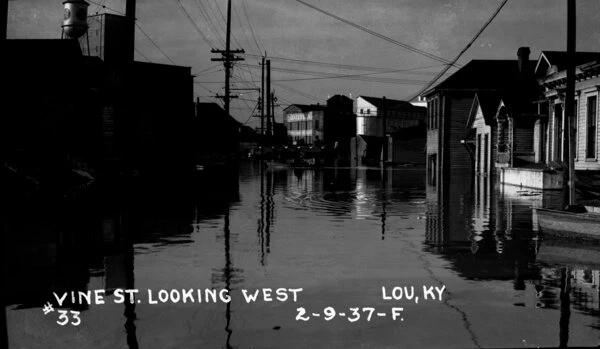
The 1937 Flood remains the most destructive natural disaster in West Point’s
history. Weeks of relentless rain swelled the Ohio River to record levels. Water covered
nearly the entire town, forcing evacuations and destroying homes, businesses, and
infrastructure.
The photograph above captures West Point during the height of the disaster — streets
transformed into waterways, power lines rising from the flood, and entire neighborhoods
submerged. Boats became the only means of travel. When the waters finally receded, the
cleanup took months, and the emotional toll lasted far longer.
Floods of the Modern Era
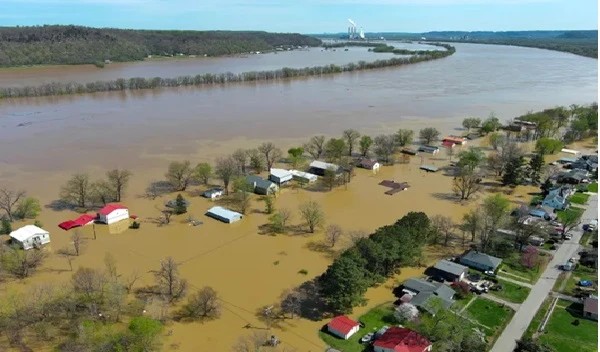
Flooding did not end with the 20th century. High water events continued into the modern era,
each one testing the community’s resolve. The photograph above shows West Point during a
recent flood — a stark reminder that the river’s power remains a constant presence.
Advances in forecasting, levees, and emergency response have reduced the impact of modern
floods, but the river still commands respect. Through every event — large or small — the
people of West Point rebuilt, repaired, and supported one another. Resilience became not
just a necessity, but a shared identity.
Measuring the River’s Memory
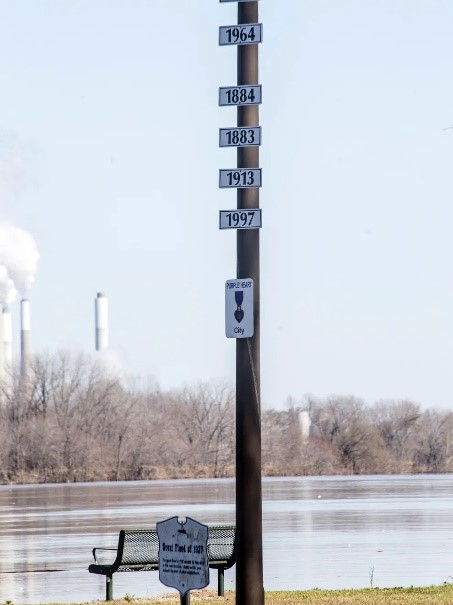
At Veterans Park, a flood gauge pole preserves the memory of West Point’s greatest high-water
events. Markers show the heights reached by the 1884, 1913, 1937, and later floods — a
vertical timeline carved by the river itself.
The pole stands as both a warning and a testament: the river has risen before, and it will
rise again. But so will the people of West Point.
A Community That Endures
of perseverance — a community that endures, adapts, and continues to stand at the meeting
place of two rivers.
© 2026 Fort Duffield • History Section