A Union family whose service, sacrifice, and leadership helped shape the early defense of Kentucky.
Explore Fort Duffield
Follow the fort’s early development, learn about the people connected to it, or explore the
research and primary sources that reveal its story.
Origins & Early History
How Fort Duffield was built and why it mattered in 1861–62.
Construction of the Fort
The labor, engineering, and hardship behind building the fort.
Timeline 1861–1862
A chronological look at troop movements and command decisions.
Garrison Life
Daily routines, hardships, slang, and soldier culture.
Strategic Tension
How a fort that never fired a shot still shaped the war.
The Naming of Fort Duffield
How the fort received its wartime and modern names.
Duffield Family
The family whose leadership and service shaped the fort’s identity.
The Duffield Family of Detroit
A Union family of faith, service, and sacrifice
The Duffields were one of Michigan’s most influential families during the Civil War.
Led by Rev. George Duffield, a nationally known Presbyterian minister,
the family became a symbol of Michigan’s early commitment to the Union. Multiple
Duffield sons entered military service, carrying their father’s strong patriotic
and religious convictions into the field.
Key Members of the Duffield Family
-
Rev. George Duffield (1794–1868)
A prominent Detroit clergyman, abolitionist, and one of the most respected
religious voices in Michigan. His sermons and writings inspired early enlistment
and shaped public support for the Union cause. -
Col. William Ward Duffield (1823–1907)
Commander of the 9th Michigan Infantry and older brother of Henry. He led the
regiment during its early campaigns and was wounded at the Battle of Murfreesboro. -
Adjutant Henry Martyn Duffield (1842–1912)
Twenty-year-old adjutant of the 9th Michigan Infantry. Later became a prominent
Detroit attorney and served as a brigadier general during the Spanish–American War.
A ceremonial sword presented to him on October 3, 1861 survives with a handwritten
family dedication.
Why Fort Duffield Bears Their Name
When Union engineers selected the high ground above West Point, Kentucky for a new
defensive earthwork in late 1861, the fort was named Fort Duffield
in honor of Rev. George Duffield. His sons were among Michigan’s earliest volunteers,
and the family’s influence symbolized the state’s devotion to the Union. The name
reflected both the military service of William and Henry and the moral leadership of
their father.
Original Sword Dedication — October 3, 1861
This is the original handwritten inscription presented to
Adjutant Henry Martyn Duffield on October 3, 1861, shortly after
his appointment to the 9th Michigan Infantry. The dedication accompanied a ceremonial
sword given by a member of the Duffield family as the regiment prepared to leave
Detroit for service in Kentucky.
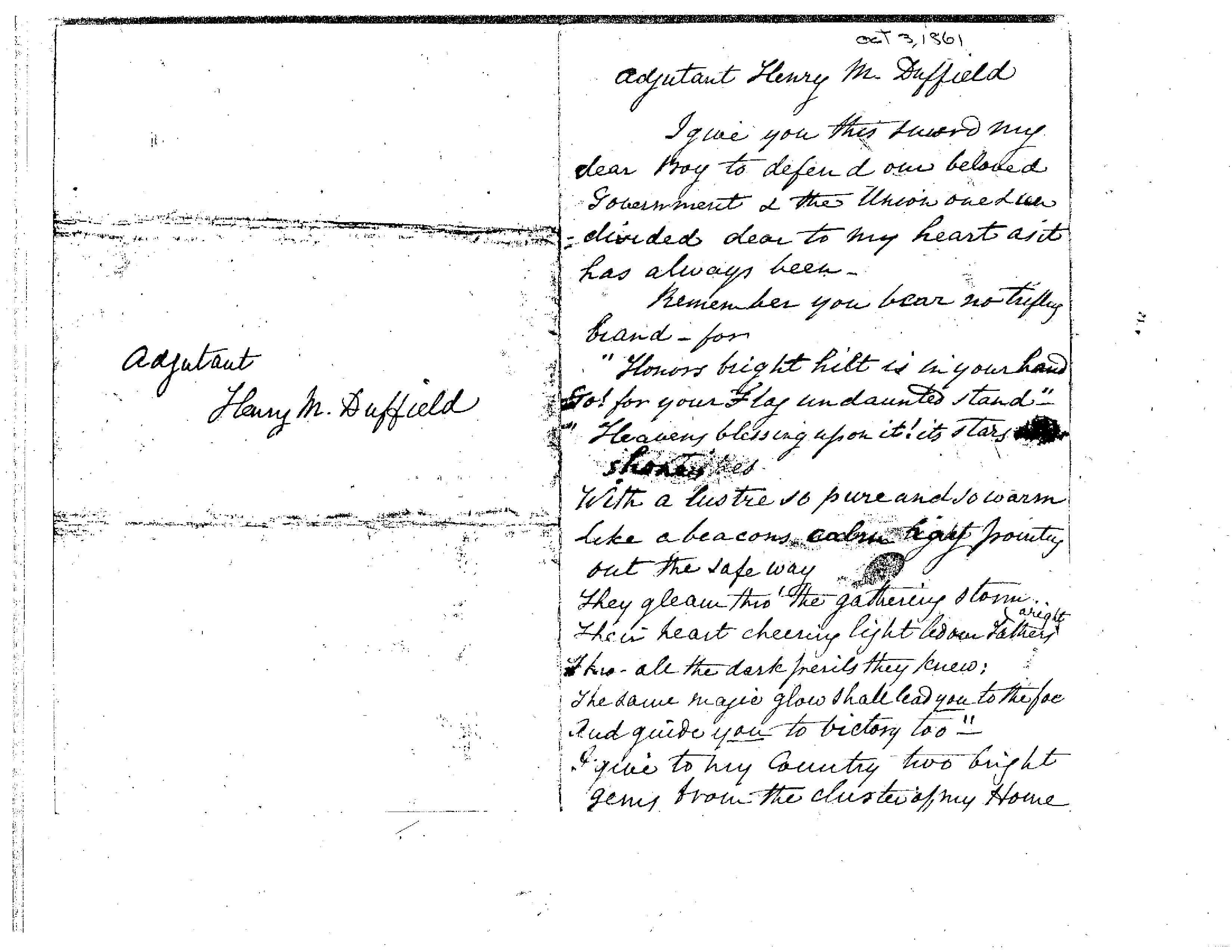
Original inscription presented to Adjutant Henry M. Duffield, October 3, 1861.
Transcription of the Dedication
October 3, 1861
I give you this sword my dear boy to defend our beloved Government of the
Union and the soldiers dear to my heart as it has always been.I remember you bear not trifly hand — for
“Honor’s bright hilt is in your hand
For your flag undaunted stand
Heaven’s blessing upon it its stars show
With a lustre so pure and so warm
Like a beacon calm & safe bounty
but the safe way
They gleam thro the gathering storm
Like heart cheering light from afar
This all the task ’twixt they knew;
The same magic glow shall beam to inspire
And guide you to victory too”I give this to my Country two bright gems, from the cluster of my Home.
Timeline: Henry M. Duffield, the 9th Michigan Infantry, and the Road to Fort Duffield
September 12, 1861 — Appointment as Adjutant
Henry Martyn Duffield is appointed Adjutant of the 9th Michigan Infantry.
The regiment organizes at Fort Wayne in Detroit under the command of his older brother,
Col. William Ward Duffield.
October 3, 1861 — Sword Presentation
A member of the Duffield family presents Henry with a ceremonial sword accompanied by a
handwritten dedication blending patriotic duty and religious encouragement.
October–Early November 1861 — Training at Fort Wayne
The 9th Michigan continues drilling, equipping, and preparing for field service.
November 12–13, 1861 — Departure for Kentucky
The regiment leaves Detroit by rail and river transport, moving south into Kentucky.
Mid–November 1861 — Arrival at West Point, Kentucky
The 9th Michigan arrives at the strategic junction of the Ohio and Salt Rivers.
November–December 1861 — Construction of Fort Duffield
Soldiers of the 9th Michigan and 37th Indiana build the large earthen fortification
overlooking West Point. The fort is named Fort Duffield in honor of
Rev. George Duffield.
Next: Little Love Letters to and from the Hill →
← Back to Origins & Early History
© 2026 Fort Duffield • Origins and Early History