returned to West Point. Their visit coincided with Louisville’s hosting of the
29th National Encampment of the Grand Army of the Republic (G.A.R.), creating
one of the largest veteran gatherings in the region’s history. For the men who once endured
hardship on Muldraugh’s Hill, the reunion was both a celebration and a pilgrimage.
Planning the Reunion
In 1895, Louisville prepared to welcome tens of thousands of Union veterans for the
29th National Encampment of the G.A.R. West Point was invited to participate,
and a local committee was formed under J. Lewis Williams and
Frank R. Lord. Their task was to locate and invite every surviving soldier
who had served at Fort Duffield.
Using regimental rosters from the 9th Michigan, 1st Wisconsin, 16th and 28th Kentucky, and
the 1st and 18th Ohio, Lord sent personal invitations across the country. The response was
overwhelming. Thousands of middle‑aged veterans — many now gray‑haired, stooped, or walking
with canes — accepted the invitation to return to the hill where they had once stood guard.
One regiment, the 37th Indiana, was not invited. The reason remains unclear.
Historians have speculated about lingering resentment toward Governor Oliver P. Morton,
the strict discipline of Colonel Hazzard, or wartime incidents involving Indiana troops,
but no definitive explanation survives.
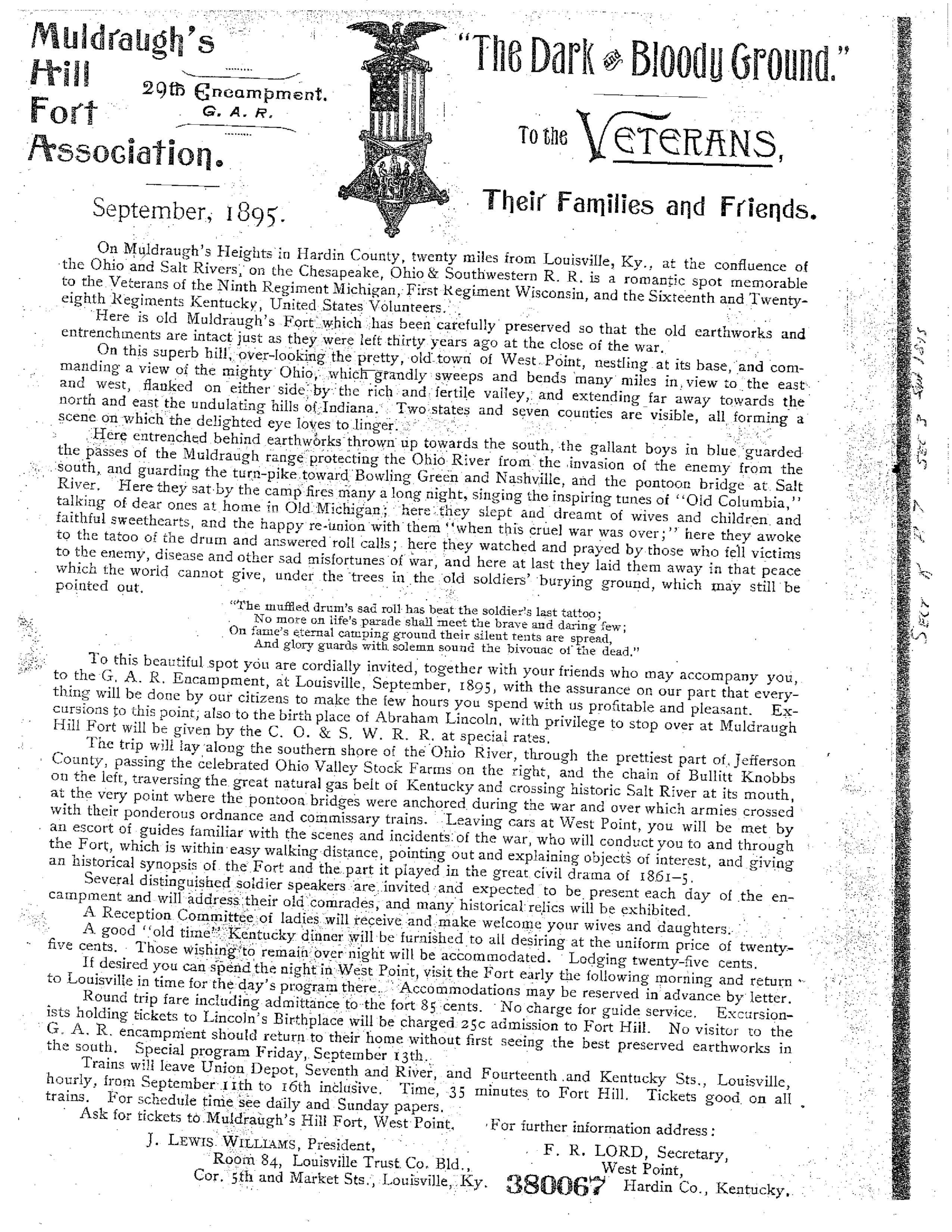
Original 1895 Reunion Letter (click to enlarge)
The original 1895 reunion letter and related materials are preserved in the author’s private collection.
A Sacred Return to Muldraugh’s Hill
When the veterans returned to Fort Duffield, many described the site as a “romantic spot”
overlooking the Salt and Ohio Rivers. Despite three decades of weather and farming, the
earthworks remained remarkably intact — a silent reminder of the winter they had endured.
Here the soldiers had once:
- Guarded the passes of the Muldraugh Hill range
- Protected the Ohio River from Confederate invasion
- Watched the turnpike toward Bowling Green and Nashville
- Defended the pontoon bridge over Salt River
- Slept, drilled, prayed, and mourned their dead
Many veterans walked to the cemetery where their comrades rested beneath the trees. A poem
recited at the reunion captured the solemn mood:
“On fame’s eternal camping ground their silent tents are spread,
And glory guards with solemn sound the bivouac of the dead.”
How the Newspapers Described the Fort
Louisville newspapers covering the reunion expressed surprise at how well Fort Duffield had
survived the passage of time. Reporters noted that the earthworks and entrenchments still
stood in impressive condition, softened only by vines and vegetation.
“Time and the elements and even the farmer’s plow have not brought any considerable change.
The high walls of the entrenchments are overrun by verdure, but it requires only a small
amount of imagination to see the cannon planted on the embrasures — to see blue‑clad men
hurrying here and there — to hear the sharp orders of soldier life and see the white tents
and flag of the country.”
The fort enclosed roughly five acres, with a sheer 150‑foot cliff forming its natural defense
on one side. From the northwest point of the hill, the trenches followed a zigzag line in an
irregular semicircle before meeting the cliff again about 200 yards away. Along this line
were seven cannon positions.
The earthworks stood six to eight feet high on the inside, and from the top of the wall to
the outside ground the drop ranged from 15 to 20 feet. The top of the wall was flat and wide
enough for four men to patrol abreast.
Even after thirty years, traces of the wartime camp remained visible: stone chimneys,
cook‑house excavations, the officers’ headquarters, and the path to the spring were all still
recognizable to the veterans who returned.
A Community Celebration
West Point transformed itself for the reunion. Banners and flags lined the streets. The old
wagon road up the hill was repaired. A Chautauqua‑style grounds was built at the fort,
complete with a welcome arch, speaker’s stand, and even a private clubhouse for honored guests.
Many of the old log cabins still stood — weathered, but recognizable. Piles of cannonballs
remained near the abandoned gun emplacements, silent reminders of the winter of 1861–62.
Visitors were offered:
- Guided tours of the fort
- Historical talks by distinguished speakers
- Exhibits of Civil War relics
- A Kentucky dinner for 25 cents
- Lodging for 25 cents a night
Excursions were arranged to both Fort Duffield and the birthplace of Abraham Lincoln,
allowing visitors to explore Kentucky’s Civil War and frontier heritage.
Faces of the Reunion
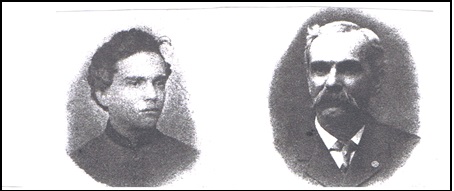
Cpl. Charles Anderson, 9th Michigan Infantry — as a young infantryman garrisoned at Fort Duffield,
and decades later at a regimental reunion.
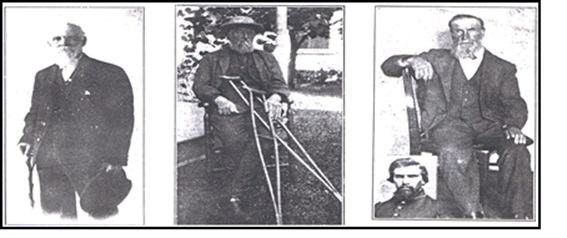
“Old soldiers never die — they just fade away.” Left to right: George W. Green (Co. A),
Sgt. Merrill Fuller (Co. A), and Sgt. William H. Ostrom (Co. K).
The 1895 Louisville Fireworks Disaster
— the first encampment ever held below the Mason–Dixon line. More than
150,000 Union veterans and visitors flooded the city between September 4–15.
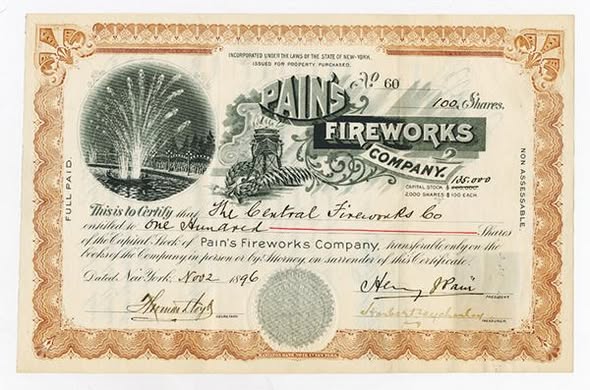
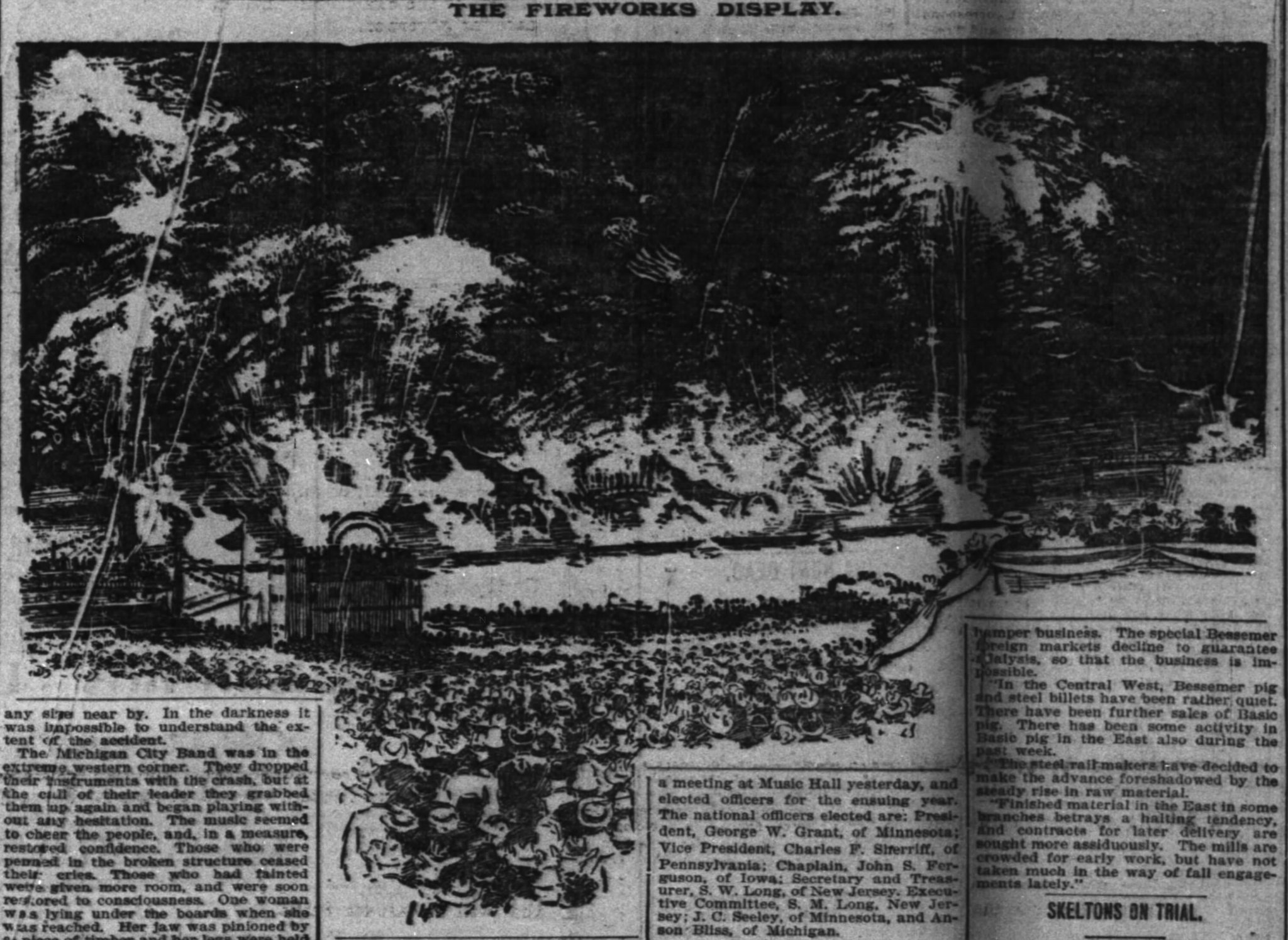
Scenes from the 1895 Fireworks Display
The Grandstand Collapse
Just before 8 PM, as the fireworks show neared its finale, the eastern section of the
grandstand built for the Citizen’s Committee collapsed. More than
4,000 people were crowded onto the structure at the time.
Thirty people were injured. Mrs. S. Hirschfield of East Market Street suffered
the worst injuries — a dislocated hip and a crushed foot. Others sustained broken legs,
sprained ankles, and dislocated shoulders. A mass panic was narrowly avoided.
The stand measured 45 by 150 feet and stood five feet off the ground. Had it been taller,
the collapse would almost certainly have resulted in fatalities.
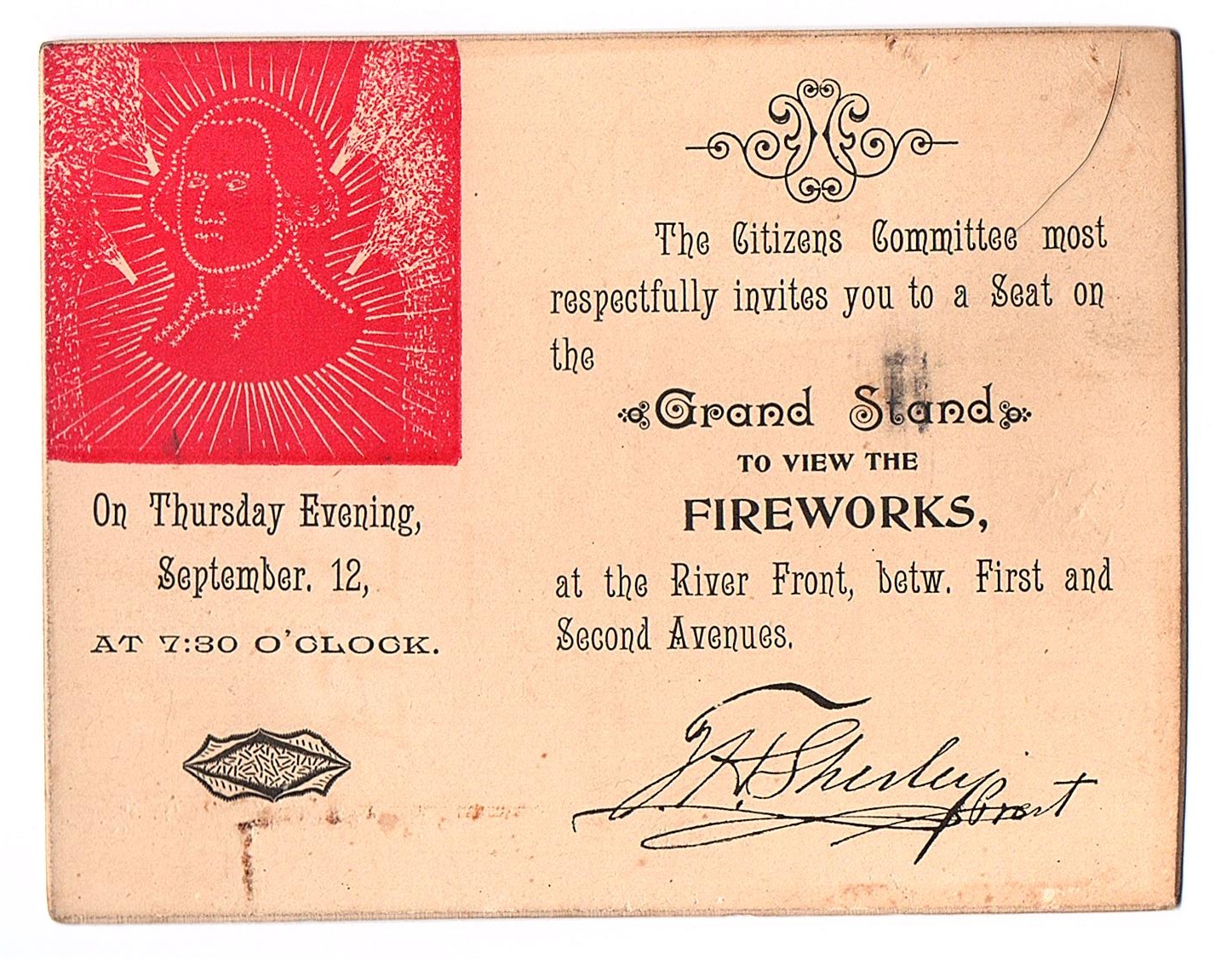
The invitation to the 1895 fireworks display and related reunion materials are part of the
author’s private collection.
The Parade, the Route, and the Phoenix Hill Explosion
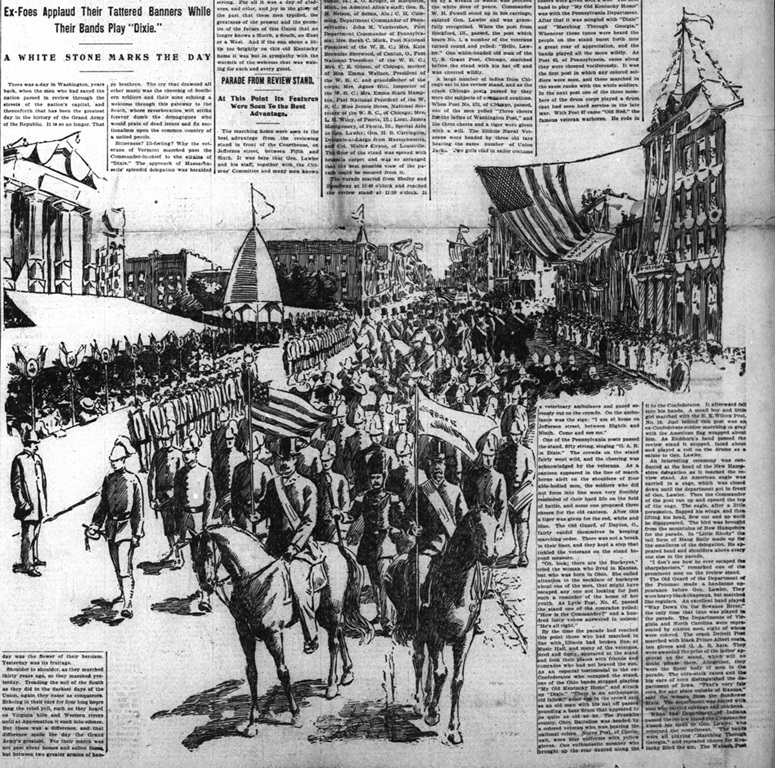
Overview of the Parade
During the 29th Encampment of the G.A.R., held September 11–13, 1895,
Louisville hosted one of the largest parades in its history. The theme of the encampment
was reconciliation between North and South, and dignitaries from both sides of the Civil War
attended. An estimated 150,000 veterans filled the city.
The parade was the highlight of the encampment. Despite temperatures reaching 94 degrees,
the streets were packed with milk carts, grocers’ wagons, and streetcars overflowing with
spectators in holiday attire. As soon as attendees stepped off the streetcars, they began
searching for a vantage point from which to watch the procession.
The Planned Cannon Salute at Phoenix Hill
Before the parade began, the Louisville Legion, Battery A, was ordered to
take two cannons to Phoenix Hill Park to fire a forty‑four gun salute.
Each cannon was to fire twenty‑two rounds of black powder.
The first cannon crew left the Armory at 5:35 PM, followed fifteen minutes later by the
second. One of the details was commanded by Captain David Castleman, who
oversaw a single cannon and its limber chest. The men were divided into two sections; the
first group of six privates guided the cannon along the parade route toward Phoenix Hill.
At the Armory, Sergeant Fred Conn prepared the powder charges under
Castleman’s supervision. Forty‑four charges, each containing one and a half pounds of black
powder, were placed in separate containers. The friction primers were stored in a sheepskin
sack, and both primers and powder bags were placed in separate compartments in the limber
chest according to safety regulations. The chest was then closed and locked.
The caisson carrying cannonballs and additional ammunition was left at the Armory. The
cannon and limber chest were hitched to the horses by William Adams, the
Black driver.
The Parade Route
The cannon and limber chest followed the parade route through downtown Louisville on their
way to Phoenix Hill Park. As they moved along Broadway, the men of the Louisville Legion
laughed and chatted, unaware of the disaster that was moments away.
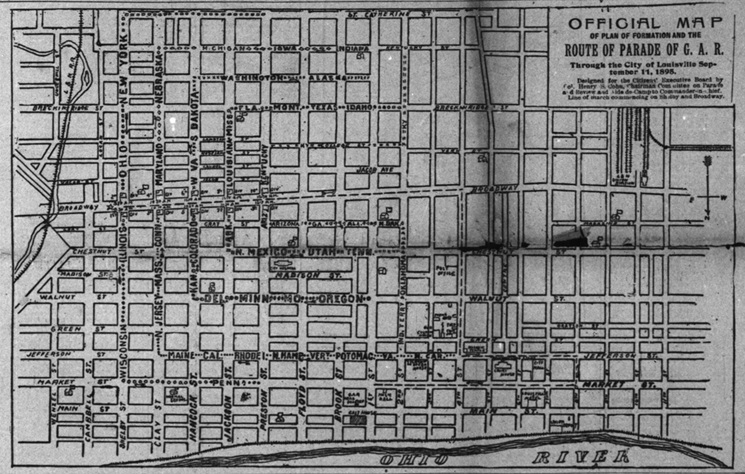
The Explosion at Fourth Avenue and Broadway
At approximately 5:50 PM, as the cannon and limber chest crossed
Fourth Avenue and Broadway, the locked limber chest exploded without
warning. The concussion shattered windows, threw bystanders to the ground, and sent debris
flying across the intersection.
Captain Castleman, riding on horseback, was thrown six feet into the air but survived
unharmed. Nearby, Mrs. Flora Foree, standing at the doorway of
Mrs. Lunsford Yandell’s home, was hurled onto the steps as splinters and
fragments tore through the house.
Witnesses described hearing a strange sound like falling rain — the noise of branches torn
from trees by the explosion striking roofs and pavement, mingled with the clatter of broken
glass. A part of a horse lay in the street; another horse, dying, lay beside the cannon
barrel. The body of Sergeant Conn was found next to the gun.
In Judge George Eastin’s yard, one hundred feet from the blast, a body was
discovered. At Fourth and Broadway lay the remains of Private Archibald McBride.
Corporal A. L. Robinson’s body was found at the home of Mr. Hull, while
Private Charles Beichner was discovered beside a telegraph pole fifty‑eight
feet away. William Adams’s body was found on the roof of Mr. Hull’s house.
Casualties of the Blast
When the smoke cleared, five members of the Louisville Legion and their driver were dead:
- Corporal A. L. Robinson, age 26
- Private Charles Woods, age 20
- Private Charles Beichner, age 24
- Private Archibald McBride, age 16
- William Adams, age 49, the driver
Two others were seriously injured:
- Sergeant Fred Conn
- Private Edward Hobbs
Emergency Response
The explosion was heard throughout the city, and alarms were quickly sounded.
Hook and Ladder Company No. 1 arrived on the scene, along with
Dr. J. B. Palmer, who began treating Sergeant Conn and Private Hobbs.
The G.A.R., the Louisville Legion, and the Police Ambulance Corps assisted in the response.
Private Hobbs was taken to his home on East Washington Street, while Sergeant Conn was
transported to Norton Infirmary. The remains of the dead were taken first
to the Armory, then to Washington Wyatt & Company for preparation.
A guard was posted over the bodies, and members of the Louisville Legion visited the homes
of the fallen to inform their families.
Aftermath and Controversy
The area was cleared of bodies and debris within hours. The parade proceeded over the very
spot where the explosion had occurred, with only minor traces of the disaster remaining.
Many members of the Louisville Legion felt the parade should have been detoured or canceled
out of respect for the dead.
Colonel John B. Castleman, commander of the Louisville Legion and father of
Captain David Castleman, stated that the cause of the explosion was unknown. One theory held
that the friction primers detonated when the wheels struck granite boulders lining the
pavement. Rumors also circulated that a cigarette or pipe had ignited the powder, but
eyewitnesses insisted no one had been smoking.
Funeral and Burial at Cave Hill Cemetery
On September 13, 1895, at 3 PM, the Louisville Legion assembled at the
Armory to escort the bodies to Christ Church Cathedral for funeral services.
Afterward, the procession continued to Cave Hill Cemetery.
The dead were interred in the Louisville Legion Lot 244, Section O. They
were laid to rest with full military honors, including several gun salutes.
William Adams was also buried at Cave Hill.
The 1896 Memorial and Buried Cannons
On September 11, 1896, one year after the explosion, the
Sons of Union Veterans and the Louisville Legion held a
memorial service for the four Legion members buried in the Legion plot at Cave Hill.
As part of the ceremony, the two cannons of Battery A were buried in the
Legion burial plot — a solemn act linking the tragedy of the parade preparations to the
broader story of Union service and sacrifice.
The Burgoo, Barbeque, Cake Walk, and Boxing Events at Wilder Park
was the massive burgoo and barbeque celebration at Wilder Park.
Contemporary reporting in the Louisville Courier‑Journal used racist language to describe African American participants. That language is preserved here in quotation marks to document the prejudices of the era, not to endorse them.
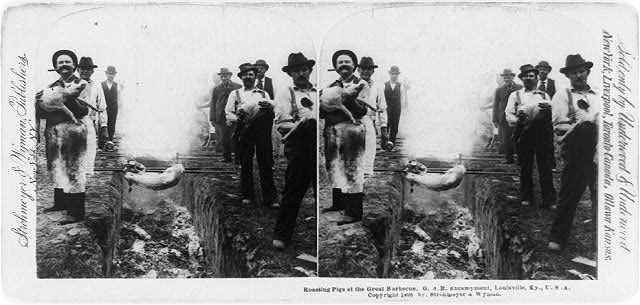
On September 14, 1895, the Citizen’s Committee announced that the day’s
festivities would “sum up the everyday life of the Sunny South,” claiming that
the “social life of the Southerner on his plantation was simple and impressive in its
primitive pleasures.” This statement framed the event in nostalgic, romanticized, and
deeply racialized terms — a tone that shaped the programming that followed.
Louisville expected to feed 300,000 guests. Wilder Park — once the Greenland
racecourse, sister track to Churchill Downs — became the center of activity. By noon,
100,000 people crowded the grounds. A massive stand,
90 by 100 feet, was erected for the cake walk and buck and wing
dances. The Grand Army Band of Canton, Ohio, under Prof. Emil Remkendorff, provided the music.
Preparing the Burgoo
Six hundred cooks and waiters worked under Gustav “Gus” Jaubert of Lexington,
the famed “Burgoo King.” Thirty thousand loaves of bread were stacked in a nearby shed.
A long trench of fires supported iron kettles holding 500 gallons each.
The ingredients — water, beef, mutton, shoat, twenty‑five dozen chickens, potatoes, corn,
tomatoes, onions, sarsaparilla, turnips, radishes, cabbage, turtles, fish, and rice — simmered
from dawn until the mixture turned a golden color.
The Courier‑Journal reported that the “busy negroes kept the fires going all night,”
and that they “peeled vegetables while they sang, danced and played on homemade banjoes.”
The Barbeque
Three trenches — each 100 feet long — were filled with glowing embers.
Fifty quartered beef, six hundred sheep, and two hundred pigs were roasted on spits.
A “corps of negroes” tended the fires to prevent burning.
By noon, the barbeque was ready. One hundred men carved the meat, which was then loaded onto
two‑wheeled trucks and distributed to fifty tables, each seating 150 people.
The Jubilee Singers and Musical Program
At 12:30 PM, three hundred jubilee singers under Colonel William S. Hays performed
“My Old Kentucky Home” and Hays’s own composition, “Hannah, Ain’t You Glad Too Come?”
The Cake Walk
The newspaper reported a delay because the “darkies” scheduled to participate
had arrived late. Prominent G.A.R. leaders and Louisville ladies were seated on the stage.
According to the Courier‑Journal, “gayly dressed darkies” in ball gowns and suits
strutted, bowed, and courtesied as the band played.
W. H. Scott of New York served as master of ceremonies.
First Prize: W. H. Pierce & Pauline McDowell — $50 in gold (≈ $1,929 today), a large cake, and a diamond‑set medal.
Second Prize: James Hall & Susan Grundy — $25 in gold.
Third Prize: Ike Berry & Annie Scott — $15 in gold.
Fourth Prize: William Grundy & Costello Chandler — $10 in gold.
Fifth Prize: Luke & Ellen Pulley — $5 in gold.
Buck and Wing Dances
Seven girls performed first; Pearlie Woods won the $25 gold prize (≈ $965 today).
The boys followed, with William Grundy winning the $10 prize.
The Boxing Match
The final event was a boxing match between J. D. Watts, the “colored heavyweight
champion of Kentucky,” and “Kid” Schofield of North Carolina.
Watts won the bout.
Heat, Thirst, and Medical Emergencies
Hydrants over ice barrels were overwhelmed by crowds suffering from heat and burgoo‑induced thirst.
Many fainted, and three ambulances with physicians worked continuously.
By 6 PM, 44,000 pints of burgoo had been served.
Legacy of the Reunion
The 1895 gathering cemented Fort Duffield’s reputation as one of the
best‑preserved Civil War earthworks in the South. It also marked the beginning of
organized preservation efforts — a tradition carried on today by the
Sons of Union Veterans and the Fort Duffield Heritage Committee.
For the veterans who returned, the reunion was more than an event. It was a pilgrimage — a
chance to stand once more on the ridge where they had endured hardship, forged friendships,
and laid their comrades to rest.
← Back to Origins & Early History
© 2026 Fort Duffield • History Section