not a quiet forest path but a busy military gateway. A wooden gate stood near this point,
controlling access to the interior of the fort. Every soldier, wagon, and supply load bound
for the fort climbed the steep road from West Point to the ridge above and passed through
this guarded entrance.
Historic View
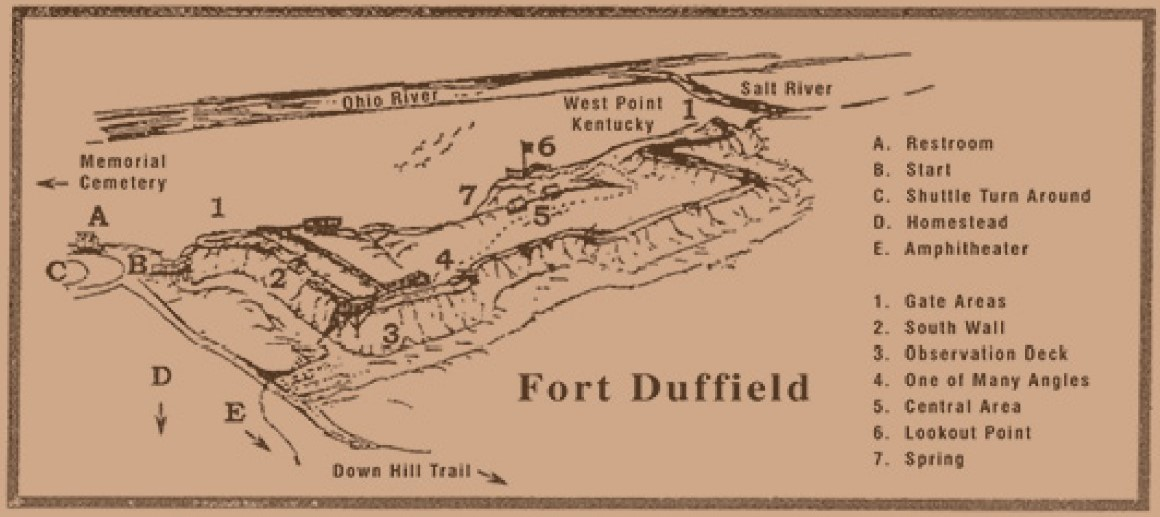
Walking Tour Map
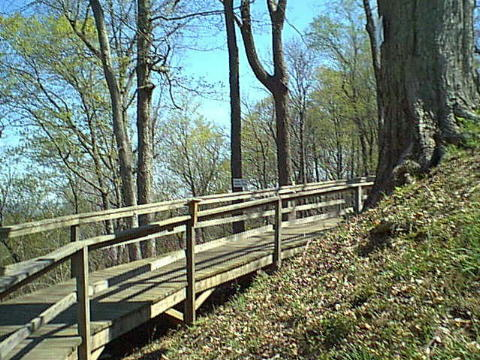
The road you see today follows the same general route used by Union soldiers in 1861.
Men of the 9th Michigan Infantry and other units hauled lumber, tools, food, ammunition,
and personal gear up this steep hillside. The climb was exhausting, especially in rain,
mud, or winter cold.
The Climb to the Fort
Historical accounts from the soldiers who built and occupied Fort Duffield describe this ascent as steep, muddy, and exhausting. Letters from the 9th Michigan and 37th Indiana mention wagons struggling to make the climb in wet weather, mules slipping on the grade, and men stopping to catch their breath as they carried tools, rations, and equipment up the ridge.
Fort Duffield in Plan
Dimensions of the Fort
Civil War engineers recorded Fort Duffield’s size in rods, a standard surveying unit of the
time. One rod equals 16.5 feet. The main enclosed fort measured:
- 27 rods long (approximately 445.5 feet)
- 10 rods deep (approximately 165 feet)
These measurements describe the central earthwork, not the extended rifle pits or outer
positions along the ridge. The fort had two gates—one near this approach from West Point
and another at the opposite end, facing the ridge and outer defenses.
What Happened Here
a. First Impressions of the Fort
For many soldiers, this approach was their first glimpse of Fort Duffield. After marching
up from West Point, they looked up to see earthworks, cabins, and tents along the ridge.
The fort seemed remote and secure, perched high above the town and the Ohio River.
b. Supply Lifeline
Every barrel of food, every crate of ammunition, and every stick of firewood had to be
brought up this road. Wagons struggled on the grade, and soldiers often had to help push
or unload. The road was the fort’s lifeline—if it were cut, the garrison would be isolated.
c. Guard Posts and the Gate
A wooden gate near this point controlled entry into the fort. Guards were posted here day
and night to challenge anyone approaching from below. Because this gate was so important,
officers went through the motions of requesting a padlock to secure it. In truth, the fort
sat on a sheer ridge, “safe as an eagle’s nest,” and the nearest enemy forces were far from
West Point. A lock would add little to what geography and distance already provided.
d. Connection to West Point
The town of West Point below was a hub of activity: river traffic, warehouses, and rail
connections. Soldiers moved between the fort and the town for supplies, orders, and medical
needs. This road tied the ridge-top fort to the wider war effort and to the communities
that supported it.
Listen or Explore More
Audio Narration
Hear how soldiers experienced the steep climb, guarded gate, and daily movements between West Point and the fort.
Primary Sources & Research
Soldiers who built and occupied Fort Duffield consistently described the climb up this ridge
as steep, muddy, and exhausting. Letters from the 9th Michigan and 37th Indiana mention wagons
scarcely able to make the ascent in wet weather, mules slipping on the grade, and men stopping
to catch their breath while carrying tools, rations, and equipment. Quartermaster notes record
repeated difficulties hauling lumber and supplies up the hill, and later oral histories preserve
soldiers’ remarks that the climb was “the worst part of the duty” during the fort’s construction.
One memorable incident involved the gate at this station. Officers formally requested a padlock,
but the request was made tongue‑in‑cheek. The fort sat on a sheer ridge—“safe as an eagle’s nest,”
as the men put it—and the nearest enemy forces were far from West Point. A lock was pointless.
Parkhurst filed the request because Army procedure required it, and the quartermaster depot
understood the joke. They sent back a tiny, toy‑sized lock, a deliberate bit of bureaucratic humor
that the soldiers never forgot. The exchange captured the Army’s dry wit and the absurdity of
applying regulations to a fort already protected by geography and distance.
From Parkhurst’s letter: he notes that the fort “stands so high and steep that no rebel could
come at us save with wings, yet the forms require a lock for the gate, and so I have asked for
one, though I think the hill itself the better guard.”